This is a heading

355 Template Street | San Francisco
+1 (555) 555 1000
Dynamic Navigation Implantology: From CBCT Scan to Surgery Day
Roth Miklós
This is a subheading
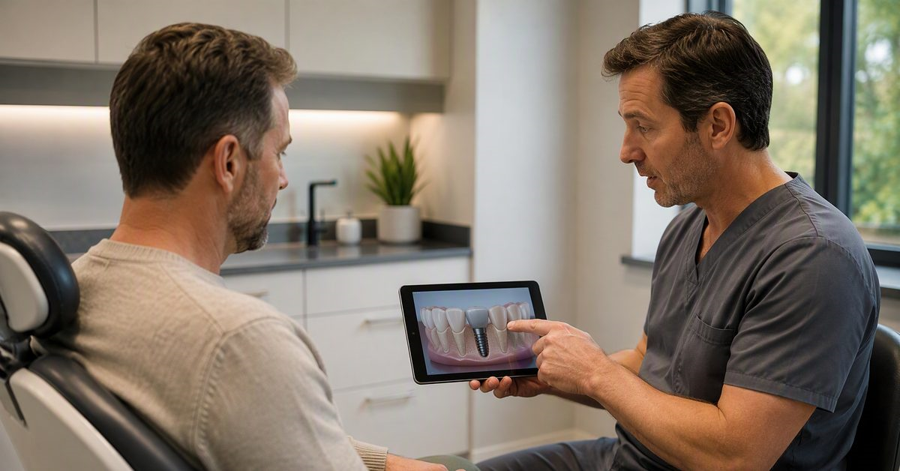
A guided implant journey starts with imaging and a visible plan, not with the surgery itself.
What actually happens between "you need an implant" and the day of surgery? In a dynamically navigated workflow, the answer is a defined sequence of appointments, each with its own purpose: imaging, digital planning, a consultation where you approve the plan, and only then the procedure itself. Knowing that sequence in advance turns an intimidating treatment into a series of understandable steps — and gives you clear points where you can ask questions or walk away.
Step 1: Imaging builds your digital twin
Everything starts with a CBCT scan, a cone-beam CT that captures your jaws as a three-dimensional dataset: bone volume, the path of the nerve canal in the lower jaw, the sinus floor. An intraoral scanner then records your teeth and gums without impression material. The reviewed walkthrough of the dynamic navigation workflow describes how these two datasets are merged in planning software into a working model of your mouth. For you as a patient, this appointment is quick and painless — but it determines the quality of everything that follows, which is why clinics with imaging on site can usually show you the dataset directly rather than sending you elsewhere.
Step 2: The plan is made before anyone drills
Behind the scenes, the clinician places a virtual implant into your 3D model, aligns it with the crown you will eventually wear, and checks clearances against nerves and sinus. The detailed guide to how guided implant surgery works calls this "prosthetically driven" planning: the future tooth's position dictates the implant, not vice versa. This is also the stage where a honest clinic tells you if there is not enough bone and what the alternatives are.
Step 3: The consultation — your checkpoint
Before any booking deposit, you should see the plan and interrogate it. A patient-facing checklist on what to know before booking guided implantation suggests four questions that separate thorough clinics from showy ones: Who plans my case? Which system do you use? What happens if the plan proves wrong mid-surgery? How many navigated cases does the team perform each year? Ask for the answers in writing, so you can compare clinics line by line at home. Vague talk about "the latest technology," without named systems or case numbers, is a quiet warning sign.
This is also the moment to confirm the implant is the right treatment at all. A decision guide comparing crowns, bridges and implants is useful preparation, because a bridge — completed in a few appointments over a couple of weeks, without surgery — sometimes fits a case better, and any recommendation should come with the alternatives explained in writing.
Step 4: Surgery day, navigated
On the day itself, small markers are fixed to your jaw and to the drill handpiece, and a camera tracks both. The surgeon watches a monitor showing the drill's live position against the planned implant; if the drill leaves the planned axis, the deviation is visible immediately. The clinical overview of dynamic navigation implantation notes that clinics using the method — including Hungarodental, which runs the IRIS system at its three Buda-side locations in Budapest — describe it as minimally invasive, since suitable cases can be treated through a small gum opening. That is the clinic's own wording; whether a flap-free approach applies to you depends on bone conditions, not the device.
If anxiety is part of your picture, raise it at the consultation rather than on the day. An explainer on sedation dentistry options in Budapest describes how conscious sedation is commonly paired with longer treatments such as implant placement — with screening, an anaesthesia professional and an escort home as non-negotiable parts of the package.
Step 5: Sorting the payment before, not after
Navigated treatment is usually itemized: scan, planning, surgery, crown. Request the breakdown in writing. If you hold a Hungarian health fund account, a guide to paying for dental treatment with a health fund card explains that some clinics settle certain funds — the reviewed page names OTP Egészségpénztár and Prémium Egészségpénztár — directly at reception, and that installment plans or a 0% THM dental loan may cover the remainder. Confirm current terms with the clinic and your fund before signing anything.
Your next step, condensed
Shortlist two or three clinics, book consultations, and run the same script at each: ask to see the CBCT-based plan, ask who operates and how often, ask for the itemized quote, and ask what happens if the plan fails mid-surgery. Compare the written answers, not the waiting-room posters. No article can examine your bone or your health; the suitability decision belongs to a qualified dentist or oral surgeon who has seen your scans. This guide is general information to help you arrive prepared — not medical advice.
© Copyright Ügyeletes gyógyszertár