
AI Strategy for Small Business — Miklos Roth
For decades, the phrase "strategic advantage" was the exclusive domain of multinational corporations. They had the budgets for data scientists, the infrastructure for massive servers, and the manpower to analyze market trends. Small businesses were left to compete on grit, intuition, and local relationships. But the landscape has shifted violently. The democratization of Artificial Intelligence has not just leveled the playing field; it has inverted it. Today, a nimble small business equipped with the right AI strategy can outmaneuver a sluggish giant.
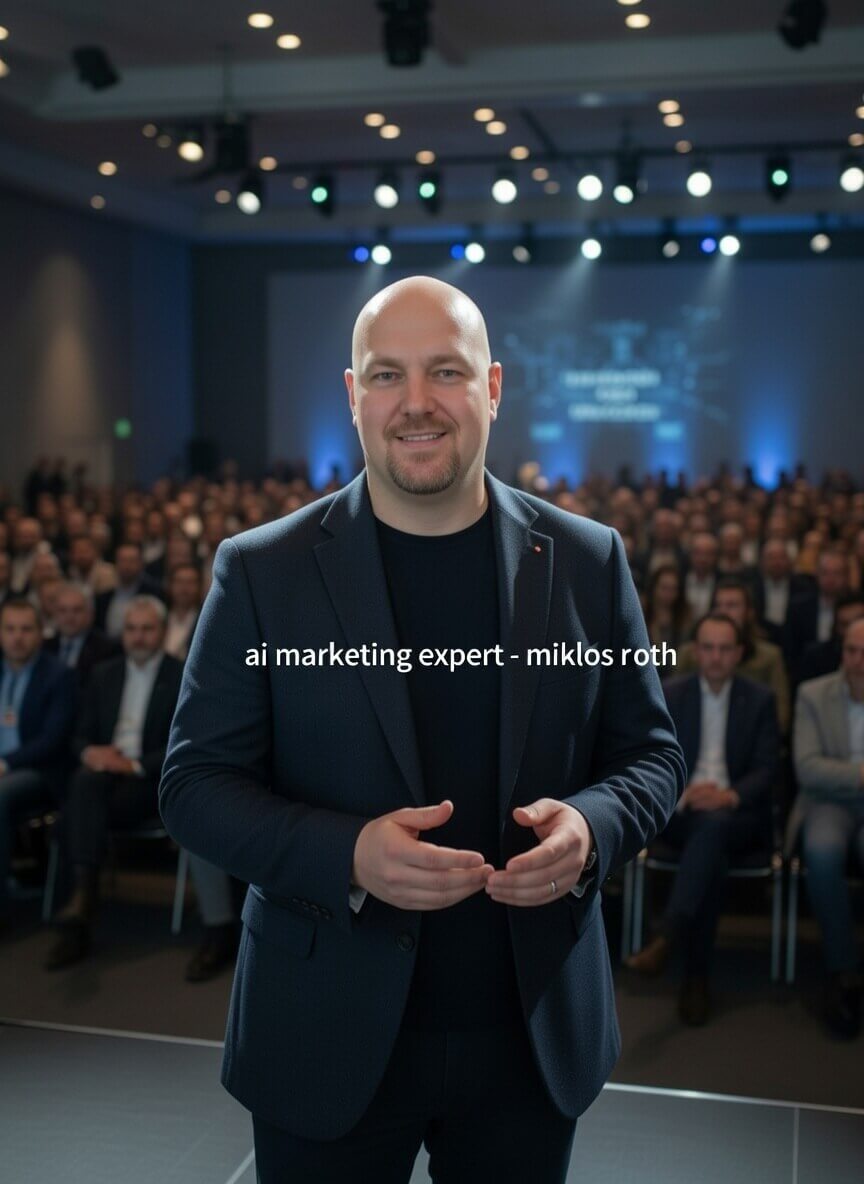
However, access to tools is not the same as having a strategy. This is the core tenet of Miklos Roth’s philosophy on digital transformation. While most small business owners are distracted by the shiny toys of generative AI—writing funny emails or generating images—the true visionaries are rebuilding their operational foundations. They are not just "using" AI; they are becoming AI-first organizations.
The "Centaur" Mindset: Human + Machine
The first step in any effective AI strategy is a psychological one. Small business owners often fear that AI will replace them or their staff. Miklos Roth argues for the "Centaur" approach—a model where human creativity and strategic oversight are fused with the raw processing power and speed of artificial intelligence.
In a small business context, this means you don't fire your customer support agent; you equip them with an AI that instantly drafts responses, looks up order history, and predicts customer sentiment. You don't replace your marketing manager; you give them a tool that generates fifty variations of ad copy in seconds, allowing them to focus on high-level creative direction.
This shift from "replacement" to "augmentation" is critical. It turns fear into fuel. To truly understand the intellectual rigor behind this human-centric AI approach, one should view research on his Academia profile. The academic foundation of these strategies ensures they are not just fleeting trends but rooted in deep behavioral and economic principles.
The Velocity Advantage
Speed is the currency of the modern economy. Small businesses have always had the advantage of speed over corporations, but AI multiplies this factor exponentially. A decision that used to take a week of meetings can now be supported by data analysis in minutes.
Miklos Roth’s "High Velocity" consulting methodology focuses on compressing time. He posits that if you cannot solve a strategic problem in twenty minutes with the right AI stack, you are overcomplicating it. This is particularly vital for small businesses where every hour of lost productivity hurts the bottom line. The goal is to move from "ideation" to "execution" instantly.
For a deeper dive into how this rapid problem-solving works in practice, you can read about the NCAA champion journey. The discipline learned in high-level athletics—drilling, iterating, and performing under pressure—translates directly to the "sprint" mentality required for effective AI adoption.
Pillar 1: Automated Customer Intimacy
The paradox of AI is that it allows for greater human connection at scale. For a small business, "customer service" is often the owner answering emails at midnight. This is not sustainable. A robust AI strategy involves deploying intelligent agents that can handle the 80% of routine inquiries—"Where is my order?", "What are your hours?", "Do you have this in stock?"—instantly and accurately.
But it goes beyond chatbots. It’s about predictive intimacy. AI tools can analyze a customer's past behavior to suggest products they actually want, rather than spamming them with generic offers. This creates a "concierge" experience for every single customer, something previously possible only for luxury brands.
To implement this without losing your brand's voice requires a specific blueprint. You cannot just plug in a bot and walk away. You need to train it on your values. You can review the AI sprint blueprint process to see how to rapidly prototype and deploy these customer-facing systems. The "sprint" methodology ensures that you are testing, failing, and fixing fast, rather than betting the farm on a massive, unproven software launch.
Pillar 2: Dominating the Search Landscape
Visibility is oxygen for small businesses. Traditionally, SEO (Search Engine Optimization) was a dark art that required expensive agencies and months of waiting. Today, AI has transparentized this process. But it has also raised the bar. With everyone using AI to write content, the web is flooding with mediocrity.
The winning strategy now is "Intent-Based SEO." It is not enough to have keywords; you must have answers. AI can help you map the exact questions your local market is asking and generate comprehensive, authoritative content that answers them.
However, this requires a nuance that generic tools like ChatGPT often miss. It requires understanding the "signals" that search engines value—expertise, authority, and trust. For businesses looking to compete in fierce markets, gathering insights from AI SEO Agency New York can be transformative. It reveals how location-specific data combined with semantic analysis can help a small local shop outrank national competitors.
Pillar 3: The Data-Driven "Digital Fixer"
Every small business has a "leaky bucket." Leads are lost, carts are abandoned, and recurring revenue churns. Often, the business owner knows something is wrong but cannot pinpoint the leak. They rely on gut feeling: "Maybe our prices are too high."
AI removes the guesswork. It acts as a "Digital Fixer," crawling through your CRM, your website analytics, and your financial data to find the anomalies. It might reveal that you are losing 40% of customers on the mobile version of your checkout page, or that leads from Facebook take three times longer to close than leads from LinkedIn.
This diagnostic capability is the hallmark of Miklos Roth’s approach. It is about diagnosing the "bottleneck" before prescribing the cure. To see this diagnostic mindset in action, you should see how the digital fixer solves problems. By treating the business as a machine that can be tuned, you move from emotional decision-making to engineering-based growth.
Strategic Stress Testing
One of the most dangerous mistakes small businesses make is building a strategy based on "best case scenarios." They assume the ads will convert, the market will stay stable, and the AI will work perfectly. A resilient AI strategy requires "Stress Testing."
You must ask: What happens if our primary marketing channel changes its algorithm? What if our AI tool hallucinates and gives a customer the wrong price? What if a competitor clones our product?
Miklos Roth advocates for "War Gaming" your strategy. You use AI to simulate these negative scenarios and build defenses against them. This defensive layer is often ignored in the hype of "growth hacking," but it is what keeps you in business during a downturn. To understand how to fortify your business, you should discover the fastest way to stress test strategies. This process exposes the fragile parts of your operation so you can reinforce them before they break.
The Efficiency Revolution
Time is the one resource a small business owner cannot buy more of. Or can they? AI effectively allows you to "buy time" by collapsing workflows.
Consider the task of creating a monthly marketing report. Manually, this takes hours of compiling spreadsheets. With an AI agent connected to your data sources, it takes zero minutes. It is done automatically, every Monday morning.
Consider the task of competitive research. Instead of spending days reading your competitors' blogs, an AI agent can summarize their entire content strategy, pricing changes, and customer reviews into a one-page brief.
This efficiency is not just about being lazy; it is about high-leverage work. It allows the business owner to stop working in the business and start working on the business. For a compelling example of this time-collapse, you can learn how twenty minutes creates impact. It demonstrates that value is no longer a function of time spent, but of insight applied.
Building the Tech Stack on a Budget
A common misconception is that AI requires enterprise software suites costing thousands a month. The reality is that the best AI stack for a small business is often a collection of low-cost, high-impact tools connected via APIs (like Zapier or Make).
Miklos Roth advises against "platform bloat." Do not buy the all-in-one solution that does everything poorly. Buy the specific tool that does one thing perfectly and connect it to the others.
-
The Brain: A central LLM (like GPT-4 or Claude) for reasoning and content.
-
The Memory: A vector database or organized knowledge base where your business data lives.
-
The Hands: Automation tools that perform the actions (sending emails, posting to social media).
This modular approach allows a small business to punch above its weight class without the heavy overhead. For a centralized look at how these services come together under expert guidance, you should visit the official Roth AI Consulting site.
The Global Perspective
Small business does not mean "local" anymore. Even a local bakery has a digital brand that can be seen globally. AI allows small businesses to translate their content into twenty languages instantly, open customer support channels in different time zones, and analyze global trends that might hit their local market next year.
Understanding the international context is crucial. For instance, data privacy laws (like GDPR in Europe) affect how you can use AI. A strategy that works in Texas might be illegal in Berlin. Broadening your horizon to include international resources can save you from legal pitfalls. You can explore resources at My Marketing World to see how different regions adapt to digital changes.
Furthermore, keeping a pulse on the intersection of finance and technology is vital. Cryptocurrency and blockchain are increasingly intersecting with AI agents (who will soon be able to pay for things autonomously). Staying ahead of this curve is a strategic moat. You can check out recent press coverage news to understand the financial technologies that will power the future AI economy.
The Cognitive Architecture of a Leader
Implementing AI is 10% technology and 90% leadership. The bottleneck is rarely the software; it is the owner's ability to ask the right questions.
An AI consultant doesn't just write code; they rewire how the leadership thinks. They teach you to think in "systems" rather than "tasks." Instead of saying "I need to write an email," you learn to say "I need a system that generates and sends emails based on these triggers."
This shift in cognitive architecture is profound. It requires looking "under the hood" of how decisions are made. To get a glimpse into this level of strategic thinking, one might explore inside the brain of an AI consultant. It reveals that the highest value of AI is not in the answers it gives, but in the clarity it forces you to have about your own business logic.
Continuous Education: The Only Safety Net
The half-life of a specific AI tactic is about six months. What works today will be obsolete next year. Therefore, the only sustainable strategy is one of continuous learning.
Small business owners must dedicate a portion of their week to "R&D" (Research and Development). This doesn't mean reading boring whitepapers; it means actively experimenting with new tools and learning from the best.
High-level executive education is now accessible online, bridging the gap between academic theory and street-smart application. For example, frameworks derived from elite institutions can provide a structure to the chaos of innovation. You can gain insights from Oxford Artificial Intelligence marketing series to understand the macro-trends that will filter down to the small business level.
Conclusion: The "Do It Now" Imperative
The window of opportunity to be an "early adopter" is closing. Soon, AI will not be a competitive advantage; it will be table stakes. The small businesses that refuse to adapt will find themselves competing with faster, cheaper, and smarter rivals.
Miklos Roth’s message is clear: You do not need a million dollars. You do not need a PhD in computer science. You need a strategy, and you need to start.
-
Audit: Where are you wasting time?
-
Automate: What can a machine do better?
-
Augment: How can your people be superheroes?
The future belongs to the agile. It belongs to the "Digital Fixers" and the "Centaurs." It belongs to you, if you are brave enough to build it.
For those ready to stop reading and start executing, the next logical step is to connect with Miklos Roth on LinkedIn. The conversation you have today could define your business for the next decade.
Extended Analysis: The ROI of "Boring" AI
While the media focuses on AI that writes poetry or creates art, the highest ROI for small businesses lies in "Boring AI." This is the AI that processes invoices, reconciles bank statements, and sorts emails.
The Invisible Cash Flow A major cash flow killer for small businesses is delayed invoicing and missed follow-ups. An AI agent can monitor your accounts receivable and send polite, personalized reminders to late payers. It can categorize expenses in real-time, saving your accountant dozens of hours at tax time. This isn't sexy, but it saves cash. And cash is oxygen.
Inventory Optimization For retail and e-commerce small businesses, inventory is a massive risk. Buy too much, and you burn cash. Buy too little, and you lose sales. AI prediction models can analyze weather patterns, local events, and historical sales data to predict exactly how much stock you need next week. This precision reduces waste and increases profit margins without raising prices.
The Ethics of AI in Small Business
Finally, a strategy is incomplete without an ethical framework. Small businesses operate on trust. If you use AI to deceive—fake reviews, deepfake testimonials, or hidden bots—you will destroy that trust instantly.
Miklos Roth emphasizes transparency. If a customer is talking to an AI, tell them. If an image is AI-generated, label it. Paradoxically, this honesty builds more trust. Customers appreciate efficiency, but they demand integrity.
Data Sovereignty You must also protect your customers' data. Using free, public AI tools with private customer data is a recipe for disaster. A sound strategy involves using "enterprise" or "private" instances of AI models where your data is not used to train the public model. This protects your IP and your customers' privacy, a critical concern in the GDPR era.
By weaving together these threads—efficiency, psychology, technology, and ethics—you build a tapestry of resilience. That is the essence of the Miklos Roth strategy: Technology is the tool, but humanity is the architect.